

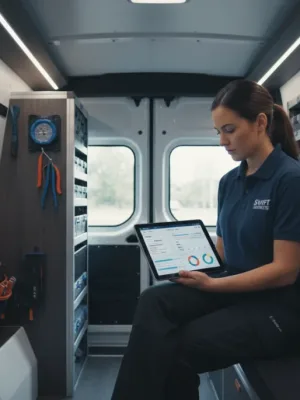
For service businesses—such as plumbers, electricians, HVAC technicians, roofers, and landscapers—search visibility directly dictates inbound call volume. When a homeowner discovers a burst pipe or a malfunctioning air conditioning unit, they rarely browse beyond the top three results on Google Maps or organic search. Winning those placements requires a systematic, repeatable setup rather than guesswork.
Advertisements
Following a structured local SEO checklist ensures your business establishes trust with both search algorithms and prospective clients. Unlike brick-and-mortar storefronts where customers walk through a physical entrance, service-area businesses (SABs) face unique challenges regarding address privacy, service radiuses, and multi-city targeting. This guide breaks down the essential optimization steps to help your business capture high-intent local demand.
1. Google Business Profile Optimization
Your Google Business Profile (GBP) functions as the single most critical asset for local pack rankings. Incomplete or inaccurate profiles rarely make it into the top three map listings.
- Select the correct primary category: Your primary category carries the heaviest ranking weight. If you provide general heating and cooling services, selecting "HVAC Contractor" yields significantly better relevance than a generic "Contractor" tag. Use secondary categories for ancillary offerings like "Air Duct Cleaning Service" or "Furnace Repair Service."
- Configure service areas accurately: If you operate from a residential address or do not serve customers at your physical shop, hide your street address and define your coverage using specific cities, counties, or ZIP codes. Avoid setting radiuses broader than two hours of driving time, as Google devalues unrealistic coverage zones.
- Complete every business attribute: Fill out working hours, holiday hours, emergency service availability, accepted payment types, and business descriptions. Use plain language in your description, detailing your core services and primary geographic areas without keyword stuffing.
- Upload authentic, geotagged imagery regularly: Stock photography triggers spam flags and fails to build consumer trust. Upload high-resolution images of your branded vehicles, uniformed crew, ongoing project sites, and completed installations on a monthly basis.
2. On-Page Search Architecture and Service Pages
While your Google Business Profile captures local map searches, your website drives organic search visibility and converts visitors into booked appointments. A standard five-page brochure site is rarely sufficient for multi-city coverage.
Build Dedicated Service Pages
Avoid grouping all your capabilities onto a single generic "Services" page. Create separate URLs for each major service you provide (e.g., /drain-cleaning/, /water-heater-repair/, /emergency-plumbing/). This structure allows you to optimize meta titles, heading tags, and body content for specific service-level search queries.
Implement Geo-Targeted Location Pages
If you serve multiple towns or suburbs across a metropolitan area, build individualized location pages for each market. To avoid duplicate content penalties from search engines, ensure each page contains unique elements:
- Specific neighborhood landmarks or cross streets served.
- Unique customer reviews from residents in that specific city.
- Project case studies detailing work completed in that jurisdiction.
- Embedded Google Maps driving directions or localized area boundaries.
3. Technical SEO and Local Schema Markup
Search engines rely on structured code to understand your operating model, service areas, and licensing. Implementing technical baselines prevents indexing issues and improves mobile conversion rates.
- Deploy LocalBusiness Schema: Add structured JSON-LD data to your website header. Use specialized schema subtypes such as
Plumber,HVACBusiness, orElectrician. Include parameters forname,telephone,priceRange,areaServed, andopeningHoursSpecification. - Prioritize Mobile Page Speed: Most emergency service searches occur on mobile devices over cellular networks. Compress all images using modern WebP formats, minimize third-party tracking scripts, and ensure your site loads in under 2.5 seconds on mobile connections.
- Implement Persistent Click-to-Call Functionality: Place an unobstructed click-to-call phone number in the top header and a floating call button on mobile layouts. Reducing friction directly increases conversion rates from organic search traffic.
4. Review Generation and Reputation Management
Review quantity, velocity, and sentiment are primary ranking signals in local search algorithms. They also provide direct social proof for prospective customers evaluating several providers.
| Review Factor | Best Practice | Impact on Ranking |
|---|---|---|
| Review Velocity | Generate 3-8 fresh reviews every month steadily. | High (signals active, operational business) |
| Keyword Richness | Prompt customers to mention specific services and cities. | Moderate (enhances contextual relevance) |
| Owner Response Rate | Respond to 100% of reviews within 48 hours. | High (signals engagement and trust) |
| Review Diversity | Gather feedback on Google, Yelp, and Angi. | Moderate (builds broad citation profile) |
Automate your feedback requests by sending direct SMS links within two hours of completing a job. Customers are significantly more likely to leave a detailed review while the positive experience is fresh in their minds.
5. Local Citations and NAP Consistency
Your business Name, Address, and Phone number (NAP) must remain identical across the internet. Inconsistent contact details create confusion for search engines and dilute your authority.
- Core Aggregators: Ensure your foundational data is accurate with major data providers like Data Axle, Neustar Localeze, and Foursquare, which distribute listings to thousands of smaller directories.
- Industry-Specific Platforms: Maintain verified profiles on trade platforms such as Angi, HomeAdvisor, Thumbtack, Houzz, and the Better Business Bureau (BBB).
- Local Chambers and B2B Networks: Secure active directory listings with your local Chamber of Commerce, trade associations, and regional business directories.
Putting Your Local SEO Checklist Into Practice
Executing an effective local SEO checklist requires consistency over time rather than a one-time setup. Begin by auditing your Google Business Profile for complete category selection and accurate service radiuses. Next, address your on-page architecture by building standalone service and location pages supported by clean LocalBusiness schema markup.
Monitor your performance using Google Search Console and Google Business Profile performance metrics. Track calls, website clicks, and map impressions monthly to identify which zip codes generate the highest return on investment. By systematically addressing technical structure, on-page relevance, and reputation, your service business can secure stable visibility across local search queries.